
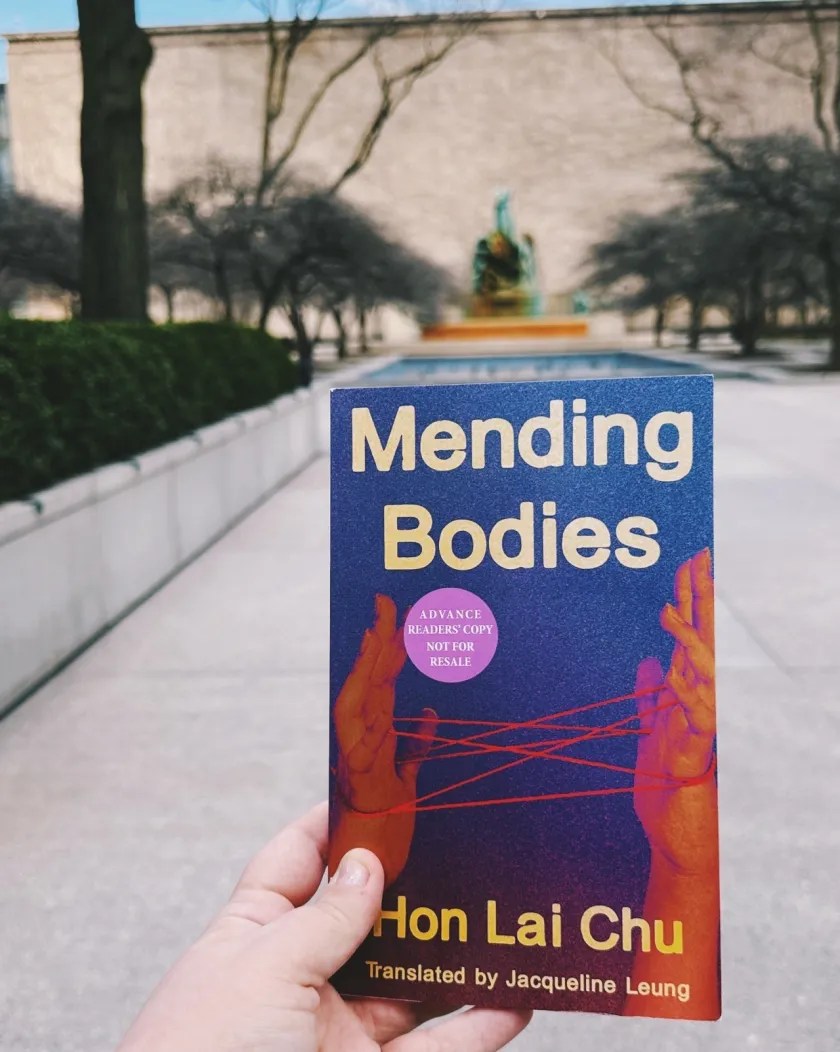
How long could you handle being in the same room with one person? A day? An hour? What about for the rest of your life? What if you weren’t stuck in the same room, but conjoined to that person, surgically together as matrimony, sharing the same bed, the same shirt, the same name even, the only thing your own being the hours you sleep and the memories from before being stitched together? Published by Two Lines Press in 2025, Hon Lai Chu’s Mending Bodies explores a dystopian city of a student narrator writing her dissertation as they grapple with mounting pressure from within and outside of themselves as the government introduces the Conjoinment Act, a move they claim will provide personal fulfillment. Hon’s use of this dystopic setting and young protagonist helps explore identity and autonomy, digging into how political motives infiltrate social norms, presenting the reader a beautifully horrific political warning.
Perhaps what catches a reader’s eye most is the title itself: Mending Bodies. Mending. As in, to sew or repair. True to the title, there is many bodies being sewn, but repair isn’t the necessary outcome. Conjoinment, as Hon describes in great and frequent detail, means that “not a single moment [passes] without the stinging that felt like ants scurrying all over [your] skin”, and how “people would exhaust themselves struggling with the bodies of other people” (4 & 11). It sounds so tiring and painful, so it should be obvious one wouldn’t pursue it, but if you did, could you take it back? Well yes, but that too offers pain as the narrator introduces her Aunt Mrytle, a women whose life post-disconjoinment consists of a lost sense of balance, support, and an arm her partner had taken in the surgery (173). Instead of offering outs or do-overs, Hon uses consequences, both for conjoinment and disconjoinment, as a way to argue against a mindset of “what happens happens”. You have to live with the consequences, and they will hurt if you don’t consider them.
Hon doesn’t just use the narrator to explore the novel’s world and themes, but she also includes “reports” in between the student’s recollections that help expand on the student’s dissertation and the world around her. A “study” of fish with two faces on one body, where, reminiscent of Gabriel García Márquez’s A Very Old Man with Enormous Wings, depicts a village that was once fascinated by the abnormality becoming worried and hateful as they saw more and more diprosopic fish, turning offerings into pest control, and escalating from fish with two-faces to undeniable violence against their fellow villagers to combat against “evil” (24-25). Another “report” the protagonists include is a court case that argued a husband’s right to be sewn to the person he loves, disregarding the partner’s ability to consent, with the case being credited as the precedent for the Conjoinment Act that promised only good (91-92). I point out these “sources” because they do two things: one, highlight Hon’s strength at building suspense as the reports stand strong as their own sort of mini-stories, and two, show the power of fear as a tool for authoritative powers. Both the fish story and the court case are cited as the in-world reasons for massive changes in society with the driving forces being fear: a fear of two-faced fish being curses and a fear that a husband may never feel complete again, pure and human fear that lead governments or other authoritative figures to push solutions that bring harm disguised as solving the problem. That, as Hon depicts, is what’s truly worth fearing as, in reality, the actions taken to soothe that fear can come at costs that one might not be prepared for.
Still, Hon offers one more crucial, real factor towards the dystopia’s creation: an Ideological Apparatus. The term, created by Louis Althusser in his Ideology and Ideological State Apparatuses, refers to the concept where state power is maintained through shaping beliefs and ideologies in social institutes such as schools, media, and families. The citizens of the city were warned of the Conjoinment Act’s faults, that it was “an elaborate political ploy to make citizens forget about their long campaign for the city’s independence”, its talk shows touting the “inability to fill the existential lack” as reason for “the obsolete institutions of marriage, racial conflict, wealth discrepancy, [and] many contrived wars”; its environmentalists with idealistic future believing conjoined couples will “consume less gas and water… space and resources” (11-12). Most importantly though, it’s the everyday people, the ones like the narrator’s mother and her friend who shame her Aunt Mrytle for disconjoining, the random citizen who attacks another for their lack of conjoinment, and the people who, as the narrator describes, “[had] a certain ambivalence towards policies [they] had no power over” which allowed “the last effective resort for protecting [their] remaining freedoms” to fall apart (12). This resignation and unquestioned trust in the government was what allowed for the Conjoinment Act to continue, as even when everyone knew what it could do, and even when everyone saw what it did, it was the everyday person who defended the Act, normalizing its place in society, that allowed it to be a part of society.
Mending Bodies is blunt, bleak and horrific at times, lacking any reassurance that the events of the novel are impossible in the real world—well, outside of physical conjoinment—and yet, it might just be what the world is now. Today, more and more of a person’s identity and autonomy becomes limited as they allow their community to tell them what’s “right”, as they allow their governments to promise them fulfillment that they believe they can’t obtain. Mending Bodies does not offer a shining, hopeful answer, but warns of a nightmare that could happen if you allow yourself to give up everything: your dreams, your autonomy, and your ability to do something about your world. However, warning is different than confirming, and while Mending Bodies might be hopeless, the world you’re living in doesn’t have to be. Take Hon’s novel not as the inevitable, but as a possibility, and use it as motivation for pursuing change.
 A Common Place
Leave a comment